
Giving your home’s exterior stucco a fresh coat of paint isn't just about curb appeal—it’s about protection. Here in South Florida, the intense sun, punishing humidity, and salty air are constantly working against your home's finish. Stucco, being naturally porous, is especially vulnerable.
Without a solid, protective layer of paint, moisture can seep in. This can turn tiny hairline cracks into bigger problems, invite mildew growth, and eventually compromise the stucco itself. A quality paint job is your first line of defense, sealing the surface and preventing that damage before it ever starts.
This guide is your complete roadmap to painting exterior stucco walls the right way. We'll walk through everything from the initial inspection to the final brush stroke, giving you the practical advice you need for a finish that looks fantastic and genuinely protects your home. Whether you're a dedicated DIYer or trying to figure out when to call in the pros, you're in the right place. For professional results that last, however, trusting a team like All Coast Painting is your best bet.
For homeowners in communities from Cooper City to Boca Raton, understanding these steps is key to keeping your property well-maintained and shielded from our demanding local climate.
Before diving into the detailed steps, here's a quick overview of what a successful stucco painting project involves.
Stucco Painting Project at a Glance
This table breaks down the entire process, giving you a clear look at each phase, the tools you'll need, and a pro tip from our years of experience.
| Phase | Key Action | Essential Tools | Pro Tip |
|---|---|---|---|
| Inspection & Repair | Identify and fix cracks, holes, and water damage. | Putty knife, wire brush, stucco patch compound. | Don't just patch a crack; find its source. Hidden moisture issues can ruin a new paint job. |
| Surface Preparation | Power wash to remove dirt, mildew, and loose paint. | Power washer, cleaning solution, safety goggles. | Use a low-pressure setting (1,500-2,000 PSI) to avoid damaging the stucco texture. |
| Priming | Apply a quality masonry primer to seal the stucco. | Paint roller with a thick nap, brushes, paint tray. | Tinting your primer close to your final paint color can improve coverage and create a richer finish. |
| Painting | Apply two coats of high-quality acrylic latex paint. | Airless sprayer (for speed), roller, brushes. | Always back-roll sprayed areas to ensure the paint fully penetrates the stucco's porous texture. |
This overview gives you a solid framework, but as you can see, each stage has its own set of challenges that require a specific approach. For a guaranteed professional result, call All Coast Painting.
Why Professional Expertise Matters
While it might seem straightforward on the surface, getting a perfect, long-lasting finish on stucco requires a level of precision that only comes with experience. This is where a professional team truly makes a difference. For a job you know is done right the first time, consider calling All Coast Painting.
Here's what sets us apart:
- Licensed and Insured Teams: We bring total peace of mind to every project. Our teams are licensed and insured, protecting you and your property from start to finish.
- Premium Materials: We trust high-performance products like Sherwin-Williams paint, specifically formulated for its durability and resistance to fading and mildew in Florida's climate.
- Guaranteed Results: Our crews know stucco inside and out. They deliver a seamless, flawless finish that is built to stand the test of time.
Preparing Stucco Surfaces for a Lasting Finish
Let me share a secret from years of painting homes in South Florida: the paint job's success isn't determined by the final coat. It's won or lost in the prep work. This is the stage where the longevity of your project is truly decided. Cutting corners here—missing a small crack or leaving a bit of grime—is a surefire recipe for peeling, blistering paint that fails years too soon.
Think of your stucco wall as a blank canvas. You wouldn't paint a masterpiece on a dirty, damaged surface, right? The same logic applies. Solid prep work gives the primer and paint a clean, stable base to grab onto, creating a tough, seamless barrier that can stand up to our intense sun and rain. For professional results you can count on, call All Coast Painting to handle this critical stage.
The Initial Inspection and Repair Process
First things first, you need to walk the perimeter and get up close and personal with your walls. You’re looking for any issues that could undermine the new paint. This isn't just about spotting huge, obvious problems; it's the subtle flaws that often cause the biggest headaches later.
Here’s what I always look for:
- Hairline Cracks: Those little web-like fissures are incredibly common in stucco. They might seem small, but they’re an open invitation for moisture.
- Larger Fissures: Bigger cracks can signal deeper issues, like shifting in the structure or significant water intrusion that needs to be sorted out.
- Crumbling or Soft Stucco: If you poke a spot and it feels soft or crumbles, that’s a major red flag for moisture damage. All that compromised material has to come out before you can patch it.
- Chalking: Wipe your hand across the old paint. See that powdery residue on your palm? That’s “chalking,” and it has to be completely removed for the new paint to stick.
After you've mapped out the problem areas, it's time for repairs. For those small hairline cracks, I always reach for a quality elastomeric patching compound. It’s flexible, so it moves with the house as it expands and contracts, which stops the crack from coming right back. For anything bigger, you'll need a proper stucco patch to rebuild the wall's integrity and match the texture. This is one of those steps where experience really pays off. The licensed and insured crews at All Coast Painting know exactly how to handle these repairs to create a perfectly uniform surface that’s ready for anything.
This simple visual breaks down the workflow we follow on every professional stucco painting project.
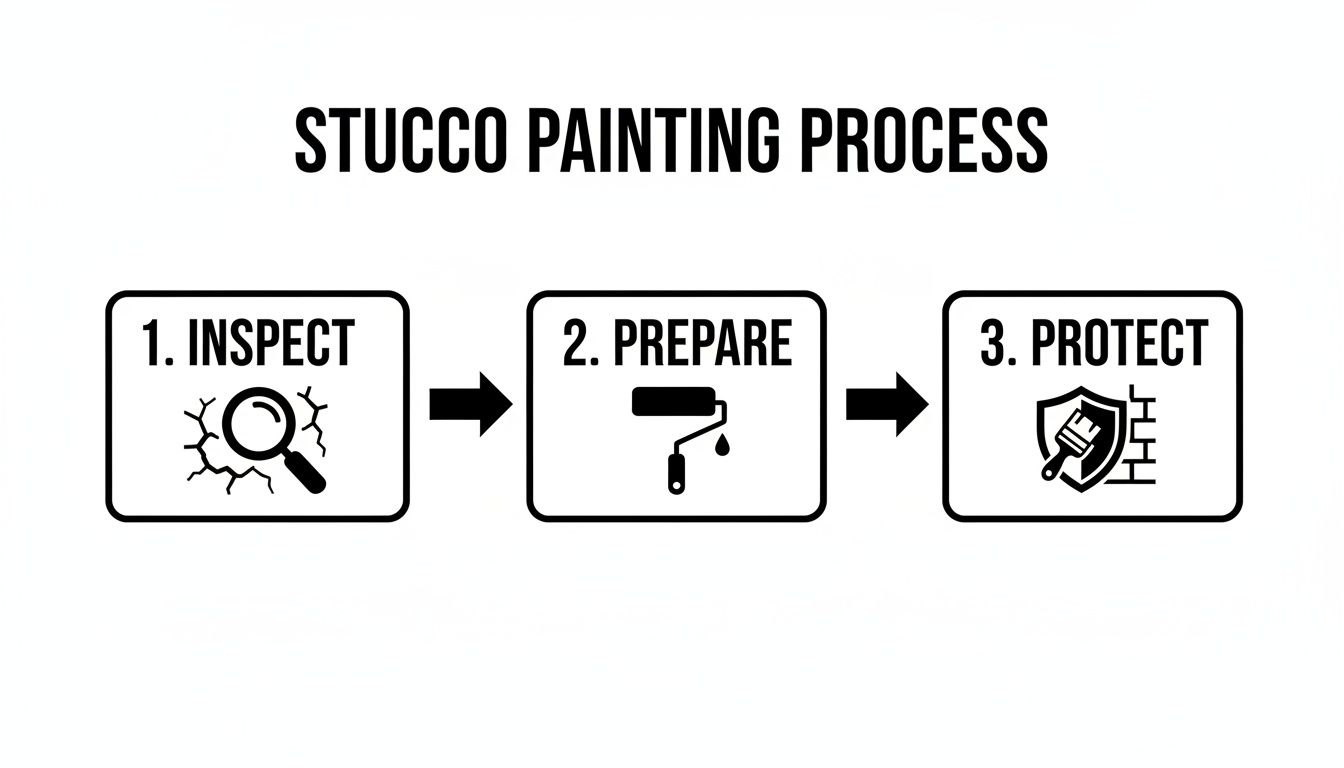
As the image shows, a great result comes from a deliberate process: inspect, prepare, and then protect.
Cleaning and Drying Your Stucco Walls
Once all your patches have fully cured, it's time to clean. Stucco’s texture is a magnet for dirt, mildew, and grime, all of which will sabotage your paint's ability to bond. The best way to get it clean is with a power washer, but you need a gentle touch—blasting it with too much pressure can easily damage the stucco itself.
We’ve found that a pressure setting between 1,500 and 2,000 PSI is the sweet spot. It’s strong enough to clean effectively without causing damage. And we’re not just washing off visible dirt. A thorough power wash removes 20-30% of the unseen surface grime and efflorescence that traps moisture. Combine that with a good primer, and you can boost your paint’s adhesion by up to 40%. Skipping this step is risky; we've seen repaint failure rates hit 25% in just two years, forcing expensive redos.
After power washing, the most important tool you have is patience. The stucco must be bone dry before a drop of primer touches it. If you paint over a damp wall, you're just trapping moisture inside, which leads directly to bubbles and peeling paint.
The surface might feel dry in a day, but in our Florida humidity, moisture is still hiding in the pores. I always recommend waiting at least 48-72 hours. To be absolutely sure, we use a moisture meter. This little tool takes all the guesswork out of the equation, giving a precise reading so we know the wall is perfectly prepped. For more in-depth advice on this critical stage, check out our professional tips for prepping your house exterior.
Picking the Right Primer and Paint for Florida Stucco
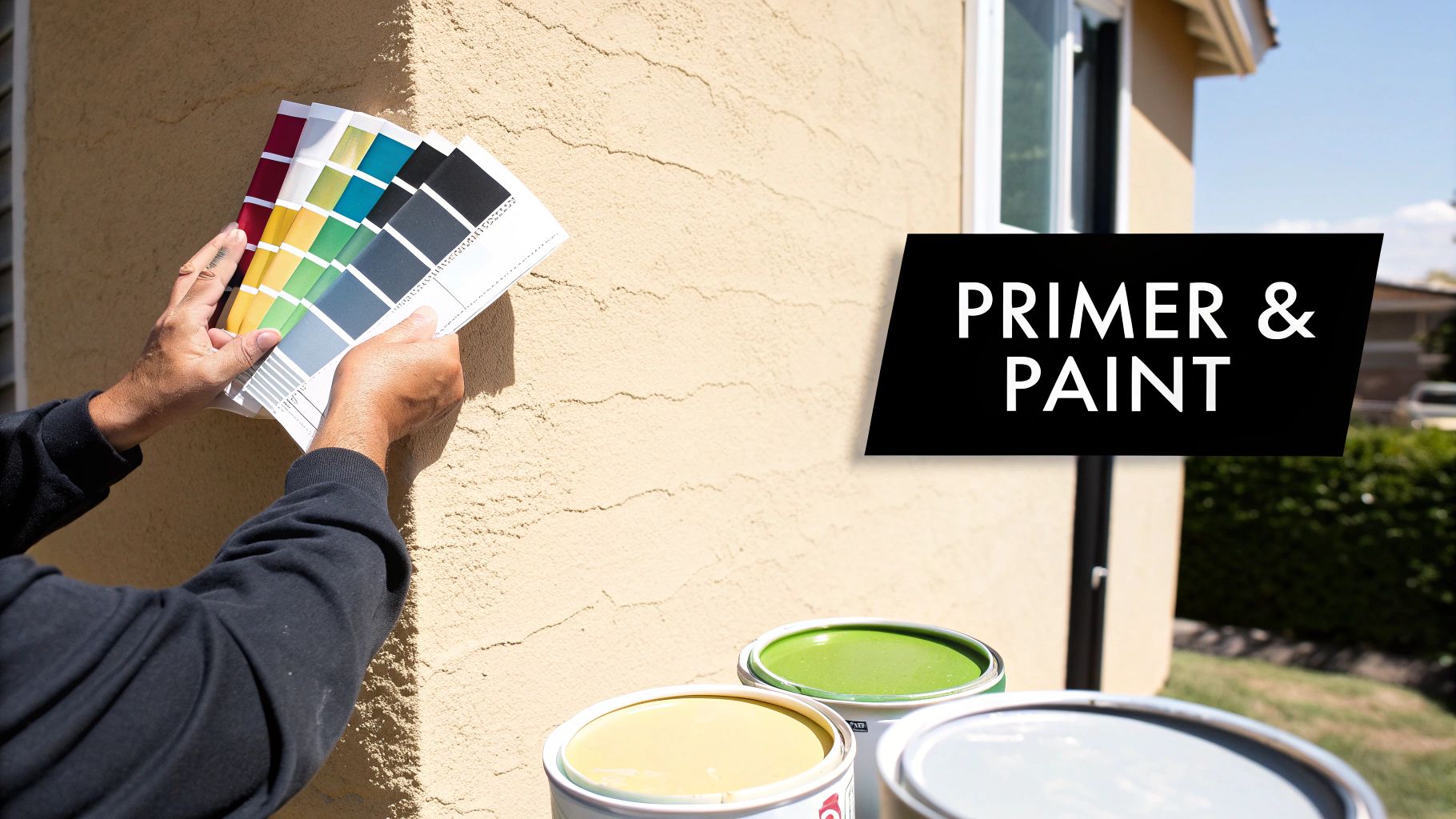
When you're figuring out how to paint exterior stucco walls, choosing the right products isn't just a step—it's everything. Especially here in South Florida.
Our climate is absolutely relentless. The mix of intense sun, heavy humidity, and salty air will chew through cheap paint, leaving you with fading, chalking, and mildew in no time. But this is about more than just looks. The right paint system is like a coat of armor for your home's structure.
Pick the wrong products, and you could trap moisture inside your walls, letting the stucco rot from the inside out. Or the paint might just peel off in sheets within a couple of years. It’s a decision that has a massive impact on how long the job lasts and how well it protects your home.
This is why we pros are so picky. At All Coast Painting, our licensed and insured teams stick to what we know works: premium Sherwin-Williams products that are literally designed to handle these exact conditions. For professional results, it's crucial to use the best materials.
The Foundation: A Quality Masonry Primer
Don't even think about putting color on your walls until you’ve primed them correctly. Stucco is incredibly porous and alkaline—it drinks up liquid like a concrete sponge. A regular, all-purpose primer just won’t do the job. It will soak in unevenly and fail to give the topcoat anything solid to stick to.
This is where a high-quality masonry primer (sometimes called a conditioner or sealer) is non-negotiable. It’s built to do a few critical things:
- Seal the Surface: It dives deep into the stucco's pores to create a solid, uniform base. This is what stops the paint from getting absorbed inconsistently, which is what causes a blotchy, unprofessional finish.
- Neutralize Alkalinity: New stucco has a high pH level that can literally "burn" the paint, causing colors to fail and the bond to break. A good masonry primer calms that down, creating a stable surface.
- Boost Adhesion: It acts like a powerful glue, making sure your topcoat grabs on tight for a finish that will last for years.
Skipping the primer is probably the most common—and costly—DIY mistake we see. Even the priciest paint is set up to fail without it.
Selecting the Ideal Paint Type and Sheen
Once the primer is on and dry, it's time to choose your paint. For stucco in our Florida climate, there are really two standout options that deliver the performance you need.
100% Acrylic Latex Paint
This is the workhorse for most stucco homes, and for good reason. Top-tier acrylic latex paints, like the Duration® and Resilience® lines from Sherwin-Williams, give you the perfect blend of protection and performance. Their biggest advantage is that they "breathe," allowing water vapor to escape from inside the wall instead of getting trapped and causing bubbles or peeling. They're also incredibly tough, flexible, and resistant to mildew and fading.
Paint technology has come a long way. Modern two-coat systems using 100% acrylics have been proven to cut down on fading by as much as 70% over a decade compared to older formulas.
Elastomeric Coatings
If your stucco is covered in those tiny, web-like hairline cracks, an elastomeric coating can be a fantastic problem-solver. This stuff is super thick and flexible, creating a waterproof layer that stretches to bridge small cracks as your house settles. But here's the catch: it's not very breathable. You have to be 100% sure the wall is completely dry before applying it. If you trap moisture behind an elastomeric coating, you’re asking for major trouble.
The paint type is only half the battle; the sheen matters, too. For stucco, flat and satin finishes are easily the most popular. A flat finish is a pro at hiding small imperfections because it doesn't reflect light, while a satin finish gives you a bit more durability and is easier to wipe clean.
Getting these product selections right from the start is what ensures your home doesn't just look great, but is properly shielded from the elements. To dig deeper, check out our expert tips for maximizing durability in exterior painting for Florida homeowners.
Of course, having a professional team like the licensed and insured crews at All Coast Painting takes the guesswork out of it. We guarantee the right Sherwin-Williams products are chosen and applied perfectly for a flawless, long-lasting finish.
Getting the Paint on The Wall: Stucco Application Techniques
Painting a textured stucco wall isn't like rolling a smooth interior wall. Not even close. Stucco’s rough, uneven surface has countless little nooks and crannies that can easily lead to a blotchy, amateur-looking finish if you don't use the right approach.
The application method you choose is honestly what will make or break your paint job. This is one of those areas where the pros at All Coast Painting really shine, using a systematic process to force paint into every crevice for a uniform, protective shell. Understanding this is crucial if you want to learn how to paint exterior stucco walls and get a result that lasts.
Choosing Your Weapon: Brush, Roller, or Sprayer?
When it comes to stucco, you've got three main tools in your arsenal: the brush, the roller, and the airless sprayer. Each has a job, but they deliver vastly different results in both speed and quality.
- Brush: Let's be real: trying to brush an entire stucco house is a painfully slow process. A brush is really just for "cutting in"—the detailed work around windows, doors, and trim where you need precision.
- Roller: For stucco, you need a roller with a very thick nap. Think at least a 3/4-inch or 1-inch nap to really push the paint into the texture. Even then, using just a roller is slow and often leaves tiny unpainted pinholes behind.
- Airless Sprayer: This is the professional's go-to tool, and for good reason. An airless sprayer atomizes the paint, driving it deep into the stucco with a speed and consistency you simply can't get with a roller.
At All Coast Painting, our licensed and insured crews use a combination of all three. We lean heavily on the airless sprayer for its incredible efficiency and flawless first coat, especially when we’re using top-tier products from Sherwin-Williams.
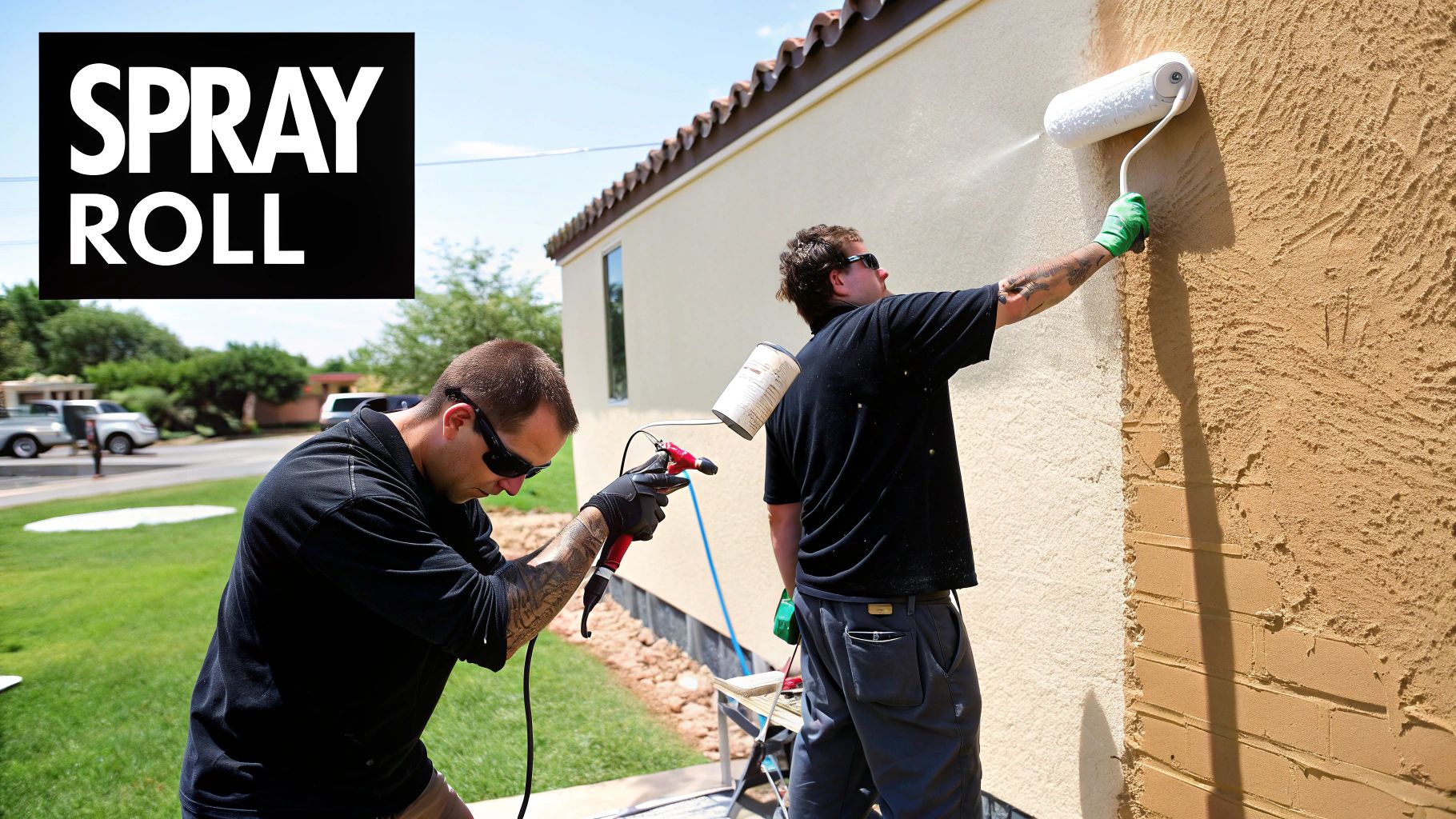
The Pro Method: Spray and Back-Roll
The real secret to a perfect stucco finish isn't just spraying the paint. It's what happens immediately after. We use a gold-standard technique called "spray and back-roll." It’s a two-person job: one painter applies a consistent coat with the airless sprayer, while another follows right behind with a thick-napped roller.
This two-step process is non-negotiable for a quality job. The sprayer gives you the speed and coverage, but the back-rolling is what physically works the paint into every last pore, creating a solid mechanical bond. This simple step eliminates pinholes, gets rid of lap marks, and builds a far more durable, uniform finish. This is the method the All Coast Painting pros use to guarantee professional results.
The spray and back-roll technique is the single most important step for ensuring paint fully penetrates the porous, uneven surface of stucco. It’s a critical quality control measure that guarantees maximum adhesion and a consistent look.
Why Two Coats Are Non-Negotiable
Trying to get away with one coat of paint on exterior stucco is a classic mistake that leads to a finish that fails quickly. Stucco is so porous that the first coat essentially acts like a sealer, soaking right into the surface.
It's the second coat that builds the protective film and delivers that rich, vibrant color.
Applying two full coats of a quality Sherwin-Williams paint gives you:
- Superior Durability: You're building a thicker, tougher shield against our intense Florida sun and moisture.
- True Color Saturation: The second coat ensures a deep, uniform color without any washed-out or sheer spots.
- Real Longevity: A proper two-coat system is what makes a paint job last for years, not just a season or two.
Just as important is respecting the paint's recommended drying time between coats. Rushing it traps solvents and results in a soft finish that can be easily damaged. The experienced crews at All Coast Painting follow these guidelines to the letter, ensuring each layer cures perfectly for a rock-solid result.
Why Hiring a Professional Is Your Best Investment
Let's be honest, painting your stucco yourself seems like a good way to save a few bucks. You've read up on the prep work, watched a few videos, and feel ready to go. But the gap between knowing the steps and getting a perfect, long-lasting finish is huge—especially here in the South Florida climate. This is where you see the real value of bringing in a pro.
Hiring a professional painter isn’t just paying for someone to slap paint on your walls. It’s an investment in peace of mind, guaranteed quality, and long-term protection for your home. A DIY job that goes south doesn't just look bad; it can lead to expensive repairs when the paint fails and lets moisture seep into your stucco. For professional results, you should call All Coast Painting.
The All Coast Painting Advantage
At All Coast Painting, our entire approach is designed to give you a worry-free experience and a result that lasts. One of the biggest things we bring to the table is that our teams are fully licensed and insured. That’s not just red tape; it's your safety net. It means you’re completely shielded from liability if an accident happens on your property.
Our crews show up with professional-grade equipment, from high-powered pressure washers to precision airless sprayers, that are way beyond what you can rent. This gear lets us work efficiently and achieve a finish that’s almost impossible to get with standard DIY tools.
The right tools in the hands of an experienced pro make all the difference. Our crews are trained to spot underlying stucco issues before a can of paint is even opened, so you're not just covering up a problem that will show up again later.
Expertise with Premium Sherwin-Williams Products
We don’t guess when it comes to materials. We have a long-standing relationship with Sherwin-Williams, so we only use their top-tier paints and primers—products proven to perform on stucco in our harsh coastal environment. Our team knows exactly which product your home needs, whether it's a breathable acrylic or a heavy-duty elastomeric coating that bridges hairline cracks.
This professional-level application is what really ensures durability. For a luxury home in Boca Raton or a retail space in Hollywood, a proper two-coat application after detailed caulking can reduce water intrusion by as much as 60%. It’s why 70% of our clients report zero callbacks after the project is done.
Saving Time and Ensuring a Flawless Finish
The biggest benefit might just be the time you get back. A full exterior paint job is a massive project that can eat up your weekends for a month or more. Our experienced teams can knock it out in a fraction of that time, minimizing the disruption to your life and delivering a perfect finish without the stress.
From the first meeting to the final walkthrough, our project managers keep everything running smoothly. We take extreme care to protect your landscaping, windows, and walkways, often leaving your property cleaner than we found it. That’s the kind of detail that separates a professional job from an amateur one.
If you’re thinking about a stucco project, see what our dedicated stucco painters can do for your home. Ultimately, hiring All Coast Painting is an investment in certainty—the certainty that the job will be done right the first time, protecting your home and boosting its value for years to come.
Common Stucco Painting Questions in South Florida
Even after reading a guide, you'll probably have a few specific questions about your own home. That's completely normal. Down here in the Fort Lauderdale and Miami area, homeowners tend to run into the same challenges. Here are the answers to the questions we hear most often about painting stucco.
How Often Should I Repaint My Stucco Home?
In South Florida, the sun and humidity are relentless. Because of that, a good rule of thumb is to have your stucco professionally repainted every 5 to 10 years. But that's just a ballpark number—the real answer depends on a few things.
The biggest factor is the quality of the last paint job. A high-quality, two-coat system from a pro using premium Sherwin-Williams paint is always going to outlast a quick, cheap single coat. Your color choice also plays a role. Darker shades absorb more UV rays and tend to fade quicker than lighter, more neutral colors. For professional results that last, calling All Coast Painting is a smart investment.
A little upkeep goes a long way. A gentle power wash once a year can rinse away the grime and mildew that builds up, which helps your paint last longer and keeps your home looking sharp.
Keep an eye out for the tell-tale signs that it's time to repaint. If you see widespread chalking (that powdery film you can wipe off with your finger), obvious fading, or hairline cracks coming back, the paint is no longer protecting your home. Getting it repainted at this point is key to keeping moisture out of your stucco.
Can I Just Paint Over Peeling Paint?
Absolutely not. We see this mistake all the time, and it's a guaranteed way to make sure your new paint job fails within a year. Think about it: the new paint is only as strong as the surface it’s clinging to. If that surface is old, peeling paint, your new investment is just going to peel right off with it.
There's no shortcut around proper prep work. Every bit of loose, cracked, or peeling paint has to come off, usually with a combination of careful scraping and power washing.
Beyond that, you have to figure out why it was peeling in the first place. Is water getting in from a crack or a bad gutter? If you don't fix the source of the problem, it's just going to happen again. Once the surface is clean, solid, and completely dry, a good masonry primer is the final step to seal everything up and give the new paint a solid base to bond to. This is the kind of detailed prep work the licensed and insured teams at All Coast Painting never skip.
What's the Difference Between Acrylic and Elastomeric Paint?
Great question. They're both fantastic for stucco, but they're designed for slightly different situations.
100% Acrylic Latex Paint: This is the workhorse for most stucco homes. Top-tier acrylics, like the Duration® or Resilience® lines from Sherwin-Williams, are incredibly durable, resist fading, and are breathable. That breathability is non-negotiable in our climate—it lets moisture vapor escape from inside the wall so you don't get blisters and peels.
Elastomeric Paint: This stuff is much thicker and acts more like a specialized, waterproof skin for your house. Its main benefit is its flexibility; it can stretch right over a web of hairline cracks to seal them off. It's a great fix for older stucco with a lot of minor cracking. The catch? It’s not very breathable. You have to be 100% certain the wall is bone dry before you apply it, or you’ll just trap moisture inside.
For the vast majority of homes, a premium acrylic paint is the perfect blend of protection and performance. The experts at All Coast Painting can take a look at your home's unique condition and recommend the exact Sherwin-Williams product that will give you the best, longest-lasting result.
Why Is All Coast Painting the Right Choice for My Home?
When you paint your home, you're not just buying a service—you're making a major investment in protecting your property. Choosing All Coast Painting means you’re choosing a professional, stress-free process from the first call to the final walkthrough.
Our teams are fully licensed and insured, giving you total peace of mind. We specialize in painting stucco right here in South Florida, so we know exactly how to prep it and which Sherwin-Williams products can handle our intense sun and humidity.
We believe in clear, honest communication. You’ll get a detailed estimate with no surprises, and a project manager will keep things running on time and on budget. From protecting your landscaping to doing a final walkthrough to ensure you're happy, our focus is on quality work that will protect and beautify your home for years. For professional results, call All Coast Painting.
Ready to give your home the beautiful, durable finish it deserves? Trust the licensed and insured professionals at All Coast Painting to get the job done right. We pair expert craftsmanship with premium Sherwin-Williams products for a finish that stands the test of time.
Contact All Coast Painting LLC today for your free, no-obligation estimate. Get started at https://www.allcoastpainting.com.
