
Yes, you can absolutely paint pressure-treated timber, but it's a project where patience is non-negotiable. The wood arrives from the lumberyard saturated with moisture and chemical preservatives, and if you jump the gun, the paint will peel and blister right off. A beautiful, long-lasting finish depends entirely on letting that wood dry out first. For professional results that last, calling the experts at All Coast Painting is your best bet.
Why Painting Pressure-Treated Timber Is a Challenge
Painting pressure-treated wood seems straightforward, but it's a classic case where a small mistake at the start leads to total failure down the road. The main problem is the sheer amount of moisture and chemicals forced deep into the wood fibers during the treatment process. Rushing the job is the #1 reason paint fails, a frustrating and expensive lesson for any property owner.
This guide walks you through the professional process our teams use every day, honed by years of working in South Florida's tough coastal climate. We'll show you how to get a finish that not only looks fantastic but also stands up to the brutal sun, salt, and humidity we get here in the Miami-Broward area.
The Problem With Trapped Moisture
Think of freshly treated wood as being completely waterlogged. When you slap a coat of primer and paint over that wet surface, you’re essentially creating a waterproof seal. But as the Florida sun starts beating down, all that trapped moisture turns to vapor and tries to escape, pushing directly against the underside of your new paint job.
This pressure inevitably leads to a few predictable outcomes:
- Blistering and Peeling: Escaping water vapor forms bubbles under the paint, which quickly break and lead to widespread peeling and flaking.
- Poor Adhesion: Primer just can't grab onto a damp surface. The bond is weak from the very beginning.
- Wood Damage: Trapping moisture inside the wood can encourage mold and mildew, and even cause the boards to warp and crack as they dry unevenly.
For professional results that last, you have to work with the wood's drying process, not against it. This is the core principle our licenced and insured teams at All Coast Painting live by. We know that proper drying is the foundation of any durable finish.
A Professional Approach Guarantees Success
Following the right steps—perfected by our skilled painters—ensures your deck, fence, or pergola becomes a lasting asset, not a yearly maintenance nightmare. We build a protective system engineered for performance by using premium products, like high-adhesion primers and durable topcoats from trusted brands like Sherwin Williams.
When you partner with All Coast Painting, you're bringing in a licenced and insured company committed to a meticulous process. We take the guesswork out of it, guaranteeing a beautiful, enduring result that protects your investment from our harsh Florida environment. For guaranteed professional results, it's always best to call All Coast Painting.
Knowing When Your Timber Is Ready for Paint
The make-or-break moment for any paint job on pressure-treated wood comes down to one thing: is the timber actually dry enough? I see it all the time—homeowners who jump the gun, armed with a can of paint and good intentions, only to watch it all peel away a few months later.
That’s because many DIY guides will point you to the "sprinkle test." Drip some water on the wood, and if it soaks in, you're good to go. Right? Wrong. Especially not here in the humid, salt-heavy air of Miami-Dade and Broward. Guessing when it comes to painting pressure treated timber is a direct path to failure.
Pros Don't Guess, They Measure
In professional painting, there's no room for guesswork. Our licenced and insured crews at All Coast Painting don't rely on folklore; we rely on data. We use professional-grade digital moisture meters to get a precise reading of the wood's internal moisture content. It's not just a suggestion—it's a critical, non-negotiable step in our process.
Why are we so obsessed with this? Because trapped moisture is the number one killer of paint jobs on treated wood.
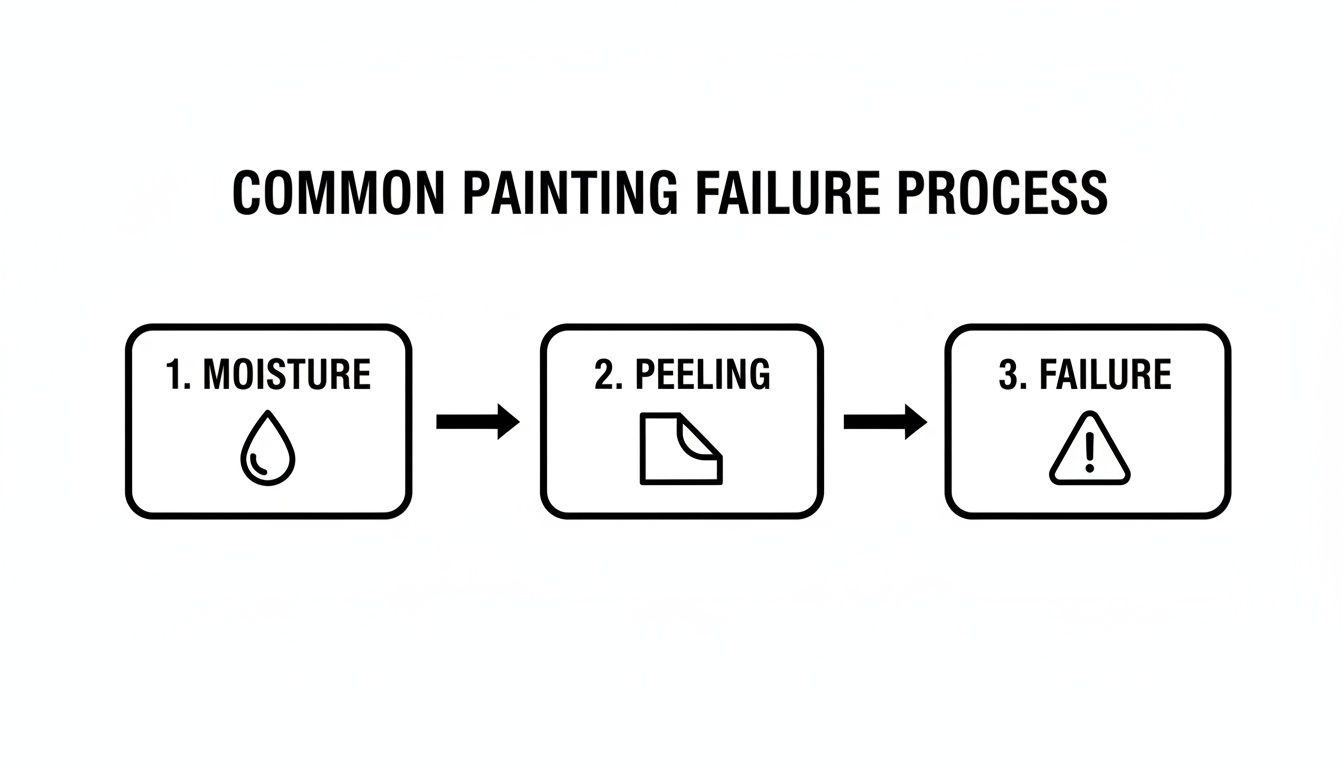
As you can see, it’s a simple, brutal chain reaction. If you seal in moisture, it will find a way out, taking your expensive paint job with it.
The Magic Number: 15%
The industry standard for painting exterior wood is a moisture content of 15% or less. If you try to apply primer to wood with a higher reading, it’s like trying to put a sticker on a wet surface—it just won't bond properly. The paint you apply on top is doomed from the start.
This is where our local South Florida climate really throws a wrench in the works. The constant high humidity slows down the drying process immensely. A new fence that might be ready in a month in a drier state could easily take four months or more to cure here.
When you hire a professional team like All Coast Painting, you're getting more than just painters. You're getting project managers who understand the science behind a lasting finish. Our licenced and insured teams monitor the timber’s moisture levels until they hit that safe zone, ensuring the surface is perfectly prepped for a premium system like Sherwin Williams paints.
Why the Sprinkle Test Is a Trap in South Florida
So, what’s the big deal with the water sprinkle test? It seems logical enough. But it only tests the very top layer of the wood, which is incredibly misleading in our coastal environment.
Here’s why it fails:
- A Deceptive Surface: One hot, sunny afternoon can bake the surface of the timber just enough to make it seem dry. It might even absorb a few drops of water, giving you a false sense of security while the core remains saturated.
- Humidity Sabotage: On a typical humid day in Fort Lauderdale or Boca Raton, the air is already full of moisture. This stalls evaporation and can make the sprinkle test give you a false "ready" signal.
- No Real Data: The test gives you a "yes" or "no" answer with no numbers to back it up. You get inconsistent results across different boards on the same deck or fence.
To give you a clearer picture, here’s how a DIY approach compares to the methods we use every day.
Timber Readiness Checklist DIY vs Professional Methods
| Check | DIY Method | Professional Method (All Coast Painting) | Why It Matters |
|---|---|---|---|
| Moisture Level | The "sprinkle test" (dripping water on the surface). | Use a calibrated digital moisture meter to get a precise percentage reading from the core of the wood. | A meter provides undeniable data (15% or less), eliminating the guesswork that leads to peeling and blistering. |
| Curing Time | A general guess based on weeks or months since installation. | Monitor the wood over time, factoring in local humidity, sun exposure, and recent rainfall. | South Florida's climate dramatically extends drying time; what works elsewhere doesn't work here. |
| Consistency | Testing one or two "representative" spots on a large structure. | Test multiple points across the entire project—shaded areas, sun-exposed spots, and different board types. | Moisture content can vary significantly from one board to the next. Inconsistency leads to patchy failure. |
| Confidence | A hopeful estimate that might work… or might not. | A data-backed decision that guarantees the primer and paint will adhere correctly for a long-lasting finish. | Confidence in your prep work is the foundation of a paint job that will endure for years, not just a season. |
Ultimately, a digital moisture meter removes all doubt. It gives us hard data, ensuring that when we begin the crucial prep work, our success is based on science, not a shot in the dark. This is the fundamental difference between a DIY attempt and the professional results you get when you call All Coast Painting.
The Pro-Level Prep That Makes a Paint Job Last
Once you’ve confirmed the timber is dry enough, the real work begins. The drying part is a waiting game, but this next phase—the prep work—is all about focused, methodical action.
This is where you can really tell the difference between a professional job and a weekend DIY project. At All Coast Painting, our licenced and insured teams treat prep as a non-negotiable protocol. We know from experience that even the best Sherwin Williams paint is doomed to fail if the surface underneath isn't prepped flawlessly. Cutting corners here isn't an option—any shortcuts will show up later as peeling, flaking, or fading.
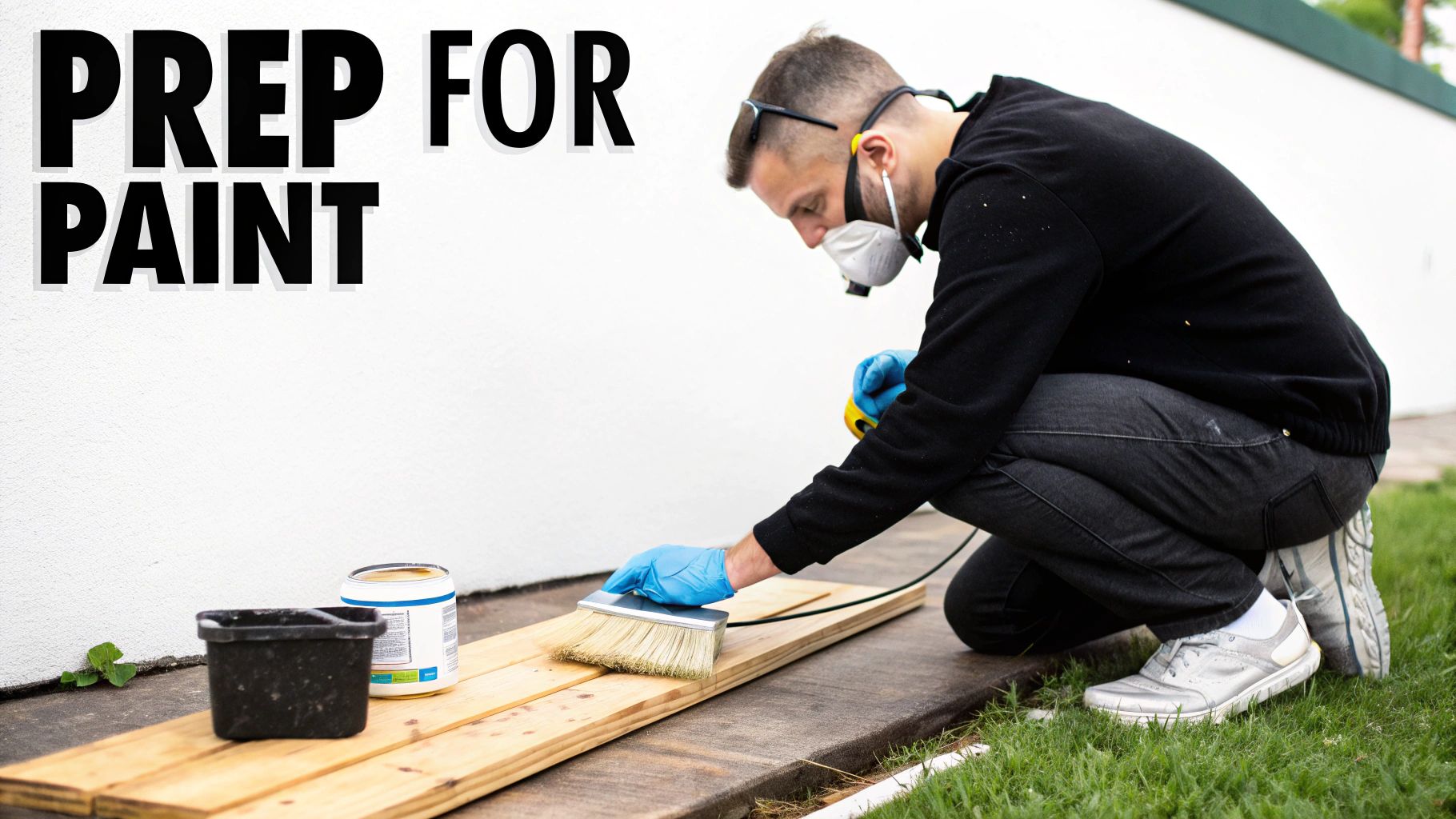
A Deep Clean That Goes Beyond the Surface
Our first step is always a thorough, controlled cleaning. New pressure-treated lumber often has a slick, waxy film on the surface called "mill scale." This stuff is a residue from the treatment process, and it's a primary reason paint fails to stick. It has to go.
Our crews use professional-grade wood cleaners and a careful, low-pressure wash to get rid of that film, plus any dirt or mildew that’s settled in. Using the right pressure is crucial. Blasting the wood with too much force will tear up the fibers, creating a fuzzy, uneven surface that will telegraph right through your final coat of paint. You can learn more about our method for safe and effective pressure cleaning services.
Strategic Sanding for Maximum Grip
After the wood is completely clean and dry again, we move on to sanding. The goal here isn't to get the wood silky smooth like you would for an indoor bookshelf. Instead, we're trying to gently open up the wood's pores, creating a textured profile that gives the primer something to really grab onto.
For this, we typically stick with an 80 to 120-grit sandpaper. It’s the sweet spot for scuffing up the surface just enough without making it too polished for the primer to bond. This mechanical adhesion is a huge part of what makes painting pressure treated timber successful.
Think of a professional paint job as a system of layers. Each layer has to be set up for success by the one beneath it. Proper sanding creates a microscopic "tooth" on the wood, giving the primer something to physically lock into. This simple step dramatically boosts the durability of the whole system.
A Growing Market for Protection
This focus on high-quality prep and premium coatings isn't just our philosophy; it reflects what's happening in the broader market. Homeowners and property managers are investing more than ever to protect their assets.
In fact, the global wood coatings market was valued at around USD 11.01 billion in 2024 and is expected to grow to USD 17.41 billion by 2032. This trend is fueled by new construction and a growing emphasis on home renovation and protection.
For us at All Coast Painting, this just reinforces our commitment to using top-tier materials from partners like Sherwin Williams and sticking to a prep process that lets those products perform at their absolute best. By the time our licenced and insured crew is done with prep, every inch of that timber is clean, dry, and perfectly profiled for primer—ready to be locked in for a finish that lasts.
Choosing the Right Primer and Paint System
Once your timber is perfectly dry and prepped, it’s time to talk products. This is where a pro's experience really shines, because grabbing any old can of exterior paint for painting pressure treated timber is a surefire way to watch your hard work fail within a year. You're not just buying paint; you're investing in a complete coating system where every layer is designed to work together.
Choosing the wrong products will completely undo all that careful prep work. A proper system ensures each coat bonds perfectly, creating a bulletproof barrier against the elements. For professional results, our licenced and insured teams at All Coast Painting exclusively use premium Sherwin Williams paints.
The Non-Negotiable Role of a High-Adhesion Primer
First up, and this part is absolutely non-negotiable, is a high-adhesion, stain-blocking acrylic latex primer. This isn't just an extra step; it does two critical jobs that are essential for a lasting finish on treated wood.
First, it’s like a microscopic anchor. Pressure-treated wood has a unique surface chemistry that a lot of standard primers just can't grab onto. A high-adhesion formula is specifically engineered to bite into those wood fibers, creating a solid foundation for the topcoat.
Second, it stops chemical bleed-through. Those copper-based chemicals that keep the wood from rotting can actually leach into your paint, causing nasty green or brown stains to appear. A quality stain-blocking primer seals the wood and locks those chemicals in, so your final color stays true.
At All Coast Painting, our licenced and insured teams rely on Sherwin Williams Extreme Bond Primer for this exact reason. Its formula is built for tough surfaces like treated timber, giving us the powerful adhesion and stain-blocking we need to build a reliable paint system from the ground up.
Selecting the Ideal Topcoat for Florida's Climate
With the primer on and fully cured, you can move on to the finish paint. For any exterior wood here in South Florida, we only use premium 100% acrylic latex paints. Oil-based paints are a terrible choice for our climate. They get hard and brittle over time and simply can't handle the way wood expands and contracts in our constant heat and humidity.
Premium acrylic latex paints, on the other hand, are designed to stay flexible. They literally move with the wood, which dramatically reduces the chances of cracking and peeling down the road. This flexibility is absolutely key to making any exterior paint job last. You can read more about our strategies for paint longevity in our guide on expert tips for exterior painting for FL homeowners.
The need for coatings that can take a beating is a global thing. The Asia-Pacific region currently dominates the wood coatings market, holding a 35.7% share in 2024, thanks to massive construction projects. It’s interesting to see that polyurethane coatings are leading the charge there because of their durability—a quality that's just as vital for a deck in Miami as it is for a skyscraper in Shanghai.
Our Recommended Paint System for Professional Results
For our clients, we stick with what works. We rely on top-tier products that have proven themselves over and over again in our brutal coastal environment. Our go-to choices are Sherwin Williams Duration® and Emerald® exterior acrylic latex paints.
Here’s why we trust this specific paint system:
- Exceptional Durability: These paints form a thick, tough film that stands up to peeling, blistering, and scuffs.
- Advanced Mildew Resistance: They’re made with special additives that fight the growth of mold and mildew—a constant battle in our humidity.
- Superior UV Protection: The pigments and binders are built to resist fading from our intense sun, keeping your color looking fresh for years.
By pairing a high-adhesion primer with a premium acrylic topcoat, we’re creating a multi-layer defense for your wood. This isn't just about making it look good; it's about providing serious, long-term protection for your investment. This is the professional standard that the licenced and insured teams at All Coast Painting bring to every single project, delivering a finish that is truly built to last.
Professional Application for a Flawless Result
You've done the hard work—you waited patiently for the wood to dry, prepped it like a pro, and picked out the perfect product. Now comes the moment of truth: the application.
How the paint actually gets onto the timber is just as crucial as any other step. A professional finish isn't just about the color; it’s about creating a consistent, durable shield. This is where the skill of a professional team really shines.
At All Coast Painting, our licenced and insured crews know that painting pressure treated timber isn’t a one-size-fits-all job. We match our application method to the specific structure—whether it's a sprawling deck or a detailed pergola—to guarantee a flawless appearance and the professional results our clients expect.
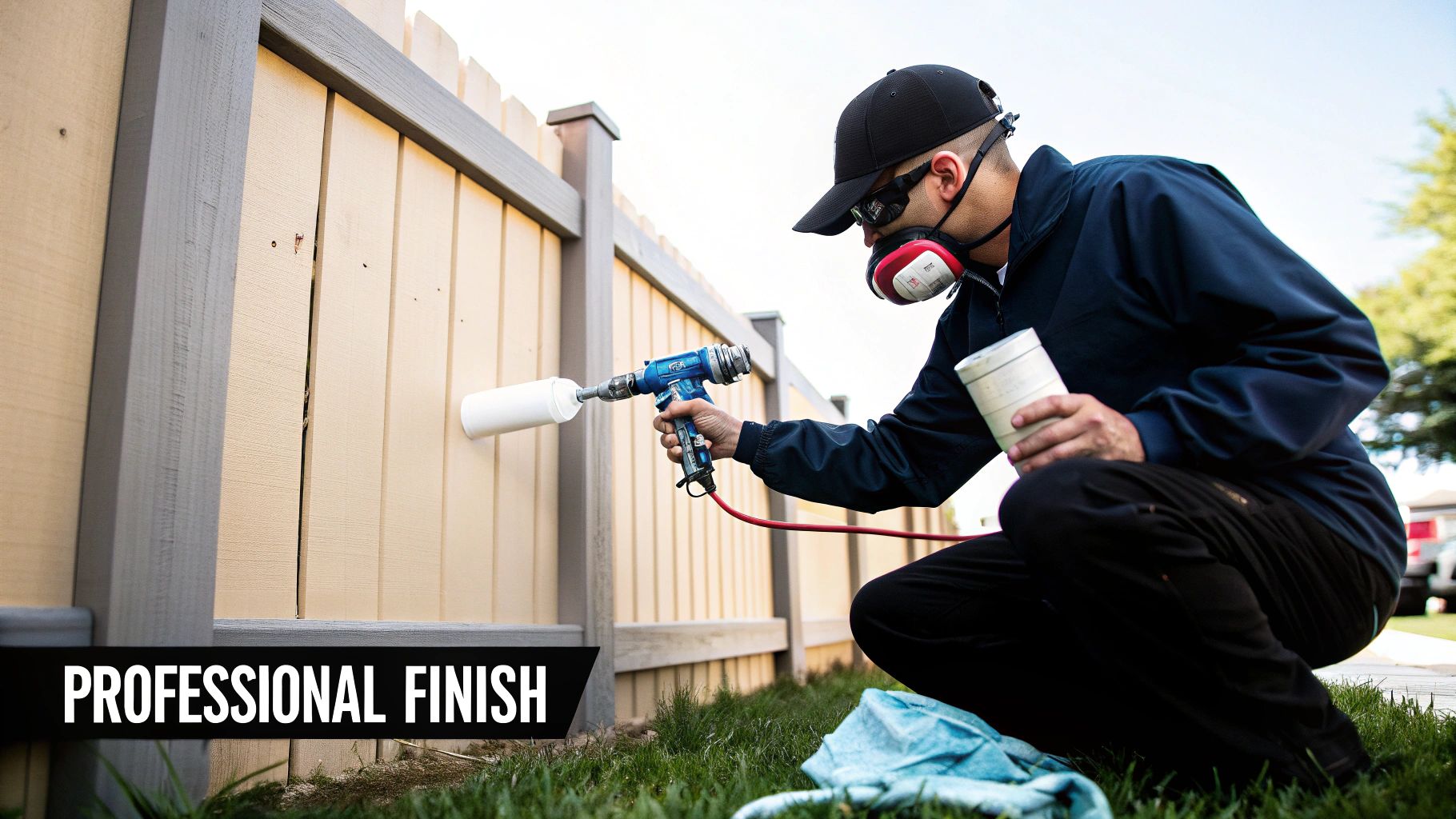
Matching the Method to the Project
The tools we choose are all about getting the best possible result efficiently. For huge, flat areas like a deck floor, rollers are fantastic for laying down a thick, even coat quickly. But for anything more complex, we switch up our technique.
- Airless Sprayers for Intricate Surfaces: Got a pergola with lots of detail, a fence with tons of spindles, or delicate lattice work? An airless sprayer is the only way to go. It turns the paint into a fine mist, letting our technicians apply a perfectly uniform coating that gets into every single nook and cranny without drips or thick, ugly buildup.
- Back-Brushing for Maximum Adhesion: Just spraying isn’t enough for a truly bulletproof finish. Right after applying a coat with the sprayer, our crews will often "back-brush" the surface. This means we take a brush and physically work the fresh paint deep into the wood's pores and grain. This simple step makes a world of difference in how well the paint bonds to the timber.
This blend of modern spray technology and classic, hands-on brushing is a cornerstone of our process. It ensures every square inch of your timber is sealed and protected.
Why Two Full Topcoats Are Our Standard
We get this question all the time: "Is one coat enough?" For us, the answer is always no.
Two full topcoats of a premium Sherwin Williams paint, like their Duration® or Emerald® lines, is our non-negotiable company standard. This isn't about selling you more paint; it’s about building the coating up to the correct film thickness specified by the manufacturer.
A single coat might look okay for a little while, but it's almost always too thin to offer any real, long-term protection from the sun and rain. Two properly applied coats create a robust barrier that gives you superior resistance to UV damage, moisture, and fading. It's the only way to get the kind of durability our clients are paying for.
Hitting that target thickness is what separates a paint job that fails in three years from one that looks great for a decade. If you're investing in your outdoor living space, understanding our process for professional deck painting shows why these details matter for a lasting finish.
Expertly Managing Environmental Conditions
Finally, even the best team with the best materials is at the mercy of Mother Nature. Our licenced and insured project managers are experts at navigating the tricky South Florida climate. We only paint within the manufacturer’s recommended temperature and humidity ranges—period.
Trying to paint when it's too hot, too cold, or too humid can completely derail the curing process. You end up with a weak finish that's just waiting to peel and fail. By controlling these variables, we eliminate the guesswork that sinks so many DIY projects and guarantee a beautiful, streak-free result that cures properly and performs flawlessly for years.
When to Call in the Pros for Your Timber Project
Let's be honest, the appeal of a weekend DIY project is strong. But when it comes to painting pressure-treated timber correctly, it’s a real investment in protecting your property. The risk of a botched job—think peeling paint, wasted weekends, and costly materials down the drain—can quickly erase any potential savings. For truly professional results, your best bet is to call All Coast Painting.
When a finish fails, you're not just losing a coat of paint. You're losing the very protection that timber needs to survive. With All Coast Painting, you’re not just hiring a crew; you’re bringing in specialists who understand the science behind a finish that lasts. Our process has been perfected over years of battling South Florida's tough coastal climate.
The All Coast Painting Advantage
Opting for our team means you get a guaranteed result built on deep expertise. We bring a level of precision and product know-how that you just can't get from a big-box store shelf.
Here’s what our professional service brings to the table:
- Expert Product Knowledge: We exclusively use premium systems from brands like Sherwin Williams, selecting the specific primers and topcoats engineered to handle punishing UV rays and relentless humidity.
- The Right Tools for the Job: From calibrated moisture meters to professional-grade sprayers, we have the specialized equipment to get a flawless, factory-like finish efficiently.
- Full Accountability: Our teams are fully licenced and insured, giving you total peace of mind. Your property is protected, our team is protected, and our work is guaranteed.
A professional paint job is far more than just brushing on color. It’s a meticulous system of analysis, prep, and application. One missed step or the wrong product is often the only difference between a finish that lasts a decade and one that’s failing after a single season.
A Worry-Free Process from Start to Finish
We handle every single detail, so you don't have to. For property owners in Cooper City, Fort Lauderdale, or Boca Raton, that means a completely seamless experience. We’ll take care of the moisture testing, the crucial prep work, and the precise application, ensuring every coat cures perfectly for maximum durability.
Don't gamble with the longevity of your deck, fence, or pergola. Contact All Coast Painting today for a detailed, no-obligation estimate. Let our expert, licenced and insured teams deliver a beautiful, professional finish that’s built to last.
Common Questions About Painting Timber
Even with the best instructions, a few specific questions always come up when it's time to paint pressure-treated timber. Getting these details right is the difference between a job that lasts and one that fails, so here are the straightforward answers to what we hear most often.
How Long Should I Wait Before Painting New Timber?
You can throw that old "wait a year" rule right out the window. While modern pressure-treated wood can be ready in 30 to 60 days, time is a terrible benchmark here in South Florida. Our constant humidity means the only reliable way to know if the wood is ready is to test it.
Our licenced and insured teams at All Coast Painting don't guess—we use a professional moisture meter. We won't even start prepping the surface until we get a reading below the industry standard of 15%. This is the only way to guarantee your primer and paint will actually stick and not peel off in a few months.
Can I Use an Oil-Based Primer?
We strongly recommend against using oil-based primers on any exterior treated wood. The new generation of high-quality acrylic latex primers, like the ones from Sherwin Williams, are far superior for our climate.
Wood is always expanding and contracting, especially with Florida’s relentless heat and humidity. Acrylic primers are designed to flex with the wood, which stops the cracking and peeling you almost always see with rigid, oil-based products. They’re also much better at blocking stains from the wood’s chemicals from bleeding through to your paint job.
How Do I Maintain My Newly Painted Deck or Fence?
Keeping your finish looking great is simple, but you have to be consistent. We tell our clients to give it a gentle wash once a year with a mild soap and a soft brush. This gets rid of the salt, dirt, and mildew that builds up. The most important thing is to avoid pressure washing at all costs—it's too aggressive and can easily strip the paint and force water deep into the wood.
Do a quick walk-around each year and look for any small chips or wear, especially on high-traffic spots like deck floors and railings. A quick touch-up right when you see it will stop moisture from creeping underneath the paint, adding years to the life of the finish.
For a flawless finish that stands up to the coastal climate, trust the experts. All Coast Painting delivers professional results with a worry-free process. Contact us for a free, no-obligation estimate today!
